
Ceviche Calories: How Many Calories Are in Ceviche?
Have you ever wondered how many ceviche calories are packed into your favorite bowl?
Knowing the calorie range can help you enjoy ceviche while staying on track with your goals—whether that’s weight loss, maintenance, or simply eating more nutrient-dense meals.
In this guide, you’ll learn how many calories does ceviche have across the most common serving sizes and styles (fish, shrimp, and mixed seafood).
You’ll also see how ingredients like avocado, olive oil, and crunchy sides can change the total.
We’ll keep things practical: quick ranges, easy comparisons, and a simple method to calculate your own ceviche at home.
Before we look at the numbers, ensure you are familiar with essential food safety tips for preparation.
Let’s dive in.
Quick references: Ceviche (Wikipedia) • Omega-3 fatty acids (Wikipedia)
- How Many Calories Does Ceviche Have? (Common Serving Sizes)
- Shrimp Ceviche Calories
- Fish Ceviche Calories
- Why Ceviche Calories Vary
- Is Ceviche Low-Calorie?
- How to Calculate Calories in Your Ceviche
- How to Make Ceviche Lower in Calories
- Frequently Asked Questions
- Conclusion
- Learn More About Ceviche Safety and Nutrition
How Many Calories Does Ceviche Have? (Common Serving Sizes)
Why you’ll see ranges: ceviche is not one fixed recipe.
Calories change based on the seafood type, the amount of avocado/oil, and whether it’s served with starchy sides (corn, sweet potato, chips).

Calories in 1 cup of ceviche
A common “bowl” serving is 1 cup (~240 g).
Most classic ceviche (lean fish + citrus + vegetables) lands around 170–280 calories per cup.
If your ceviche includes avocado or added oil, the same cup can jump to 280–450+ calories, depending on how much is used.
Calories in 100g of ceviche
Looking at a smaller, standardized portion (100 g) is helpful for comparing recipes.
Most ceviche falls around 70–120 calories per 100 g for lean versions.
Using oily fish (like salmon) or adding calorie-dense extras can raise this to 120–190 calories per 100 g.
Calories in a restaurant portion vs homemade
Restaurant ceviche portions often exceed 1 cup and frequently include avocado, oil, or chips on the side.
It’s common to see a full restaurant portion land around 350–650 calories (sometimes more with chips).
Homemade ceviche lets you control portions and ingredients.
A generous homemade cup can stay around 170–280 calories when kept “classic” (lean seafood + citrus + vegetables).
Quick calorie comparison table
| Type of ceviche | Calories (per 100 g) | Calories (per 1 cup ~240 g) | What changes it |
|---|---|---|---|
| Lean white fish (tilapia/cod/snapper) | 70–110 | 170–260 | Very low fat; veggies and citrus dominate |
| Shrimp ceviche | 75–95 | 180–230 | High protein; usually low added fat |
| Oily fish (salmon/mackerel) | 120–190 | 290–430 | More fat (incl. omega-3) = more calories |
| Mixed seafood (fish + shrimp + scallops) | 90–150 | 220–360 | Depends on ratios and add-ons |
| Any ceviche + avocado (≈100 g avocado) | +160 | +160 | Avocado adds healthy fat and calories |
| Any ceviche + 1 tbsp olive oil | +119 | +119 | Oil is calorie-dense even in small amounts |
Authority nutrition database: Use USDA FoodData Central to look up calories for your exact seafood and add-ons.
Shrimp Ceviche Calories
How many calories are in shrimp ceviche (1 cup)
Shrimp ceviche calories are usually modest because shrimp is naturally lean and high in protein.
For 1 cup (~240 g), a typical range is 180–230 calories, depending on how much tomato, onion, and other vegetables are included.
If your shrimp ceviche includes extra oil, avocado, or chips, the total can increase quickly.
Shrimp ceviche calories per 100g
For a standardized portion, 100 g of shrimp ceviche is typically about 75–95 calories.
- Protein: often the dominant macro (shrimp is very protein-rich)
- Carbs: usually low unless corn/sweet potato is added
- Fat: low unless avocado or oil is included
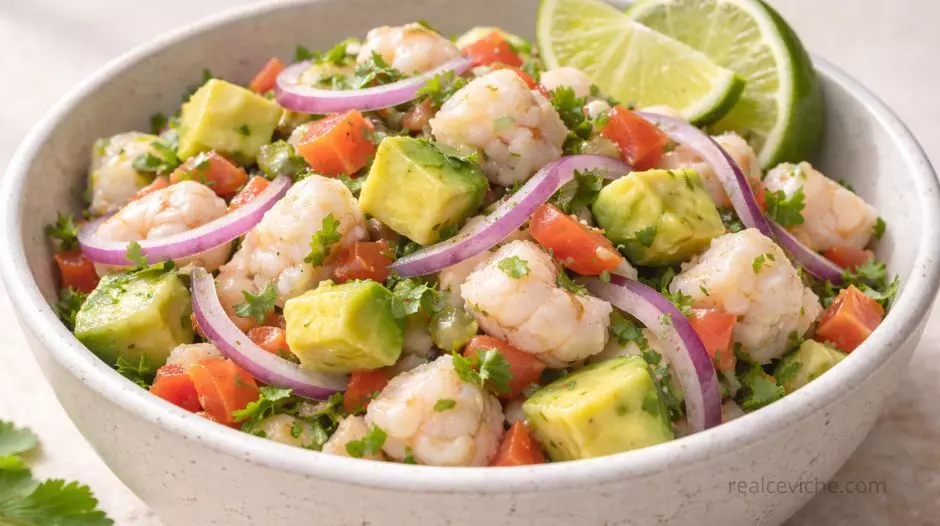
Shrimp ceviche with avocado: calorie impact
Avocado adds creaminess and healthy fats, but it’s calorie-dense.
Adding about ½ avocado (~100 g) contributes roughly 160 calories.
That means a cup of shrimp ceviche can move from ~180–230 calories to ~340–390 calories depending on portion size and mix-ins.
Fish Ceviche Calories
Calories in ceviche with lean white fish
Fish ceviche calories are lowest when using lean white fish such as tilapia, cod, or snapper.
A typical range is 70–110 calories per 100 g, or 170–260 calories per cup (~240 g).
Lean fish ceviche is often a high-protein, low-fat choice—especially when you keep the recipe citrus-forward (lime juice / lemon juice) and heavy on vegetables.
Calories in ceviche with oily fish (salmon, etc.)
Using oily fish like salmon increases calories because fat content is higher (even though those fats can be beneficial).
Expect roughly 120–190 calories per 100 g, or 290–430 calories per cup.
Oily fish can also provide more omega-3 fatty acids, which many people include for overall heart-health patterns.
Mixed seafood ceviche calories (fish + shrimp + scallops)
Mixed seafood ceviche varies the most because portions are harder to estimate.
A common range is 90–150 calories per 100 g, or 220–360 calories per cup.
- More shrimp usually keeps calories moderate
- More salmon/oily fish pushes the total higher
- More add-ons (avocado, oil, chips) can turn it into a calorie-dense meal
Why Ceviche Calories Vary
Seafood type and portion size
Seafood is the “base calorie driver.”
Lean fish and shrimp usually keep calories lower, while salmon and other oily fish raise them.
Portion size matters just as much.
Doubling from 1 cup to 2 cups can double calories—especially if it’s served with sides.
Added fats (olive oil, avocado)
Added fats are the fastest way to increase total calories:
- Olive oil: ~119 calories per tablespoon
- Avocado: ~160 calories per ~100 g (about ½ medium avocado)
Carbs and add-ons (corn, sweet potato, plantain, chips)
Traditional sides and add-ons can push ceviche from “light” to “meal-sized.”
Common estimates:
- Corn: ~70 calories per ½ cup
- Sweet potato: ~90–110 calories per ½ cup
- Tortilla chips: often ~140–160 calories per small serving
Marinade extras (sugar, sauces, mayo-based mixes)
Classic ceviche relies on citrus juices (lime juice / lemon juice), salt, and herbs—usually low in calories.
But sugar, creamy sauces, or mayo-based mixes can add 50–200+ calories quickly depending on the amount.
Is Ceviche Low-Calorie?
When ceviche is low-calorie
Ceviche is typically a low-calorie, nutrient-dense option when it’s built like this:
- Lean seafood (shrimp or lean fish)
- Lots of vegetables (tomato, red onion, cilantro, jalapeño)
- Mostly citrus + salt for the marinade (minimal oil)
When ceviche becomes calorie-dense
Ceviche becomes more calorie-dense when you add:
- Avocado (easy +160 calories per ~100 g)
- Olive oil (easy +119 calories per tbsp)
- Chips or starchy sides (corn/sweet potato/plantain)
Also, large restaurant portions can turn a light appetizer into a full-calorie meal fast.
How to Calculate Calories in Your Ceviche
Step 1 — Estimate Seafood Calories
Start with the seafood weight (a kitchen scale helps).
Then look up calories for your specific seafood in USDA FoodData Central.
Quick rule: lean fish and shrimp generally come in lower per gram than salmon and other oily fish.
Step 2 — Add Calories from Extras
Add in the calorie “boosters” you used:
- Avocado: ~160 calories per ~100 g
- Olive oil: ~119 calories per tablespoon
- Chips: often 140–160 calories per small serving
Step 3 — Divide by Serving Size
Total your ingredients, then divide by servings.
Example: if the full batch totals 720 calories and you split it into 4 servings, that’s 180 calories per serving.
How to Make Ceviche Lower in Calories
Choose lean fish or shrimp
For the lowest-calorie ceviche, prioritize shrimp or lean white fish.
These options keep fat lower while still delivering plenty of protein.
Use less avocado and oil
If you love avocado, reduce the portion or use it as a garnish rather than a base.
Swap added oil for extra lime juice, lemon juice, herbs, and a touch of jalapeño heat.
Replace chips with veggie dippers
Chips are tasty—but they add calories fast.
Try dipping with:
- Cucumber slices
- Bell pepper strips
- Jicama sticks
Add volume with low-cal vegetables
Boost portions without many calories by adding more vegetables:
tomato, red onion, cilantro, cucumber, and peppers are classic and low-cal.
Frequently Asked Questions
Is ceviche a healthy option for weight loss?
It can be—especially when it’s made with lean seafood and lots of vegetables.
For weight loss, focus on portion size and be mindful with avocado, oil, and chips.
Can I use frozen seafood for ceviche?
Yes. Many people prefer previously frozen seafood for parasite risk reduction (common practice for raw preparations).
For food safety basics, consult the FDA food safety guidance and buy seafood from reputable sources.
What vegetables can I add to ceviche?
Great low-cal add-ins include tomatoes, red onion, cilantro, cucumber, and jalapeño.
They add crunch and volume without pushing calories much higher.
Can I make ceviche with different types of fish?
Yes—tilapia, cod, snapper, and salmon are common choices.
Just remember: oily fish typically increases total calories in ceviche fish.
How long can I store ceviche in the fridge?
Ceviche is best fresh.
As a general rule, store it cold in an airtight container and aim to eat it within 1–2 days for best quality and safety.
Conclusion
Ceviche calories depend on seafood type, portion size, and add-ons.
Lean fish and shrimp ceviche are usually the lowest, while salmon ceviche and versions with avocado/oil/chips are higher.
This makes lean fish a staple for those wondering how ceviche supports weight loss and overall wellness..
To stay on track, weigh your ingredients, use USDA lookups, and keep calorie boosters measured.
With a few smart swaps, you can enjoy ceviche as a satisfying, protein-rich meal—without guessing.
Next step: Make your next batch with lean seafood + extra vegetables, then calculate the total once (you’ll reuse that estimate every time).
Learn More About Ceviche Safety and Nutrition
Explore our specialized guides to master everything from nutritional profiles to essential storage and preparation safety standards.
How Long Is Ceviche Good For? (Safety Guide & Tips)
Is Ceviche Healthy? Weight Loss Benefits, and Safety
Is Ceviche Raw or Cooked? The Truth About Acid-Cured Fish
Is Ceviche Safe to Eat? Risks and Safety Guidelines
Ceviche Nutrition Facts: Protein Content and Nutrient Profile
Can I Eat Ceviche While Pregnant? Safety Facts & Risks
